Photo spot in Bayeux & the D-Day Beaches
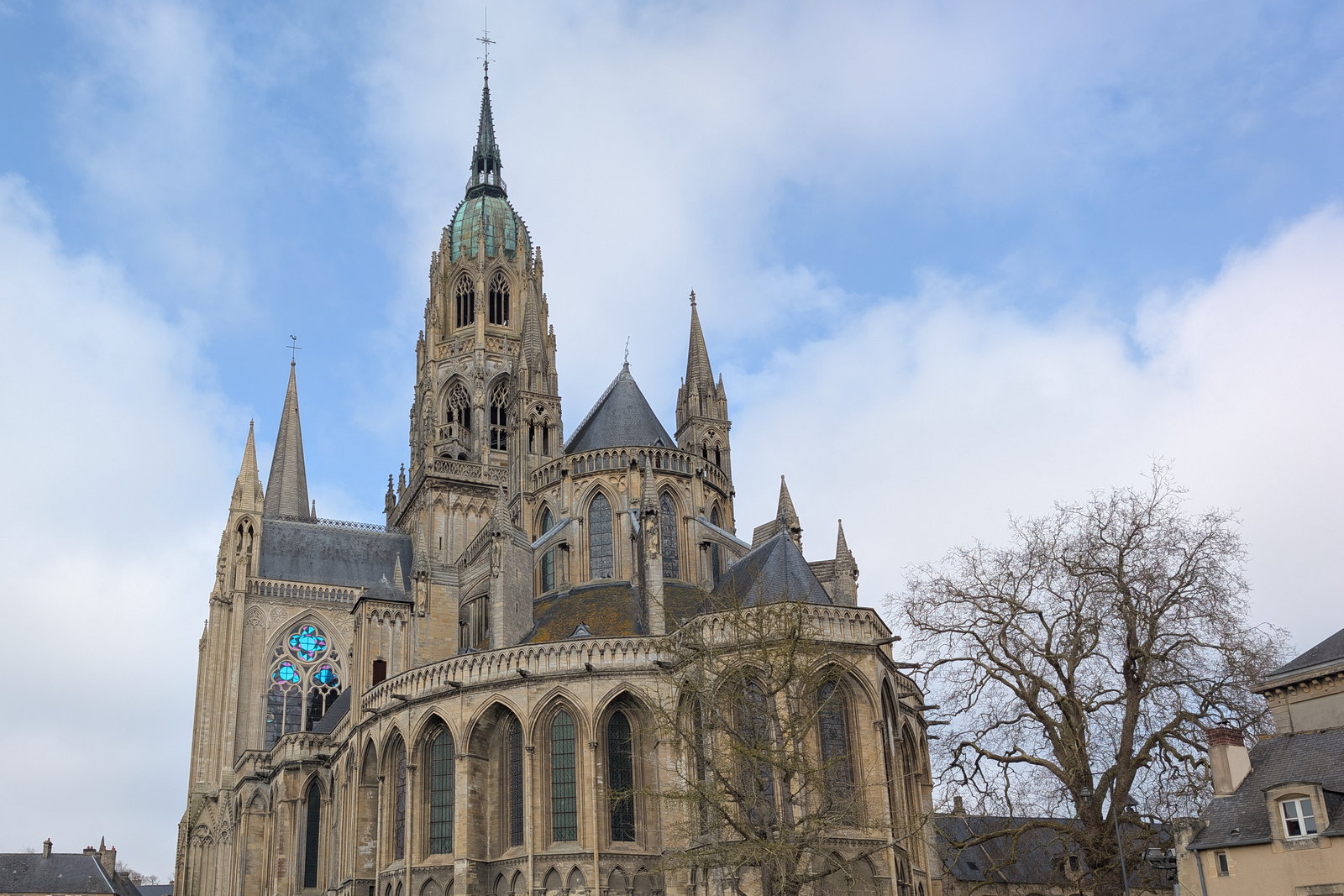
Bayeux cathedral and the mill races of the Aure
A Romanesque nave under a Gothic upper church, a green-copper lantern tower — and, five minutes below it, a waterwheel turning behind the houses.
About Bayeux cathedral and the mill races of the Aure
Get directionsNotre-Dame de Bayeux is the one building that fixes the town: a Romanesque nave and crypt carrying a Gothic upper church, two western spires, and a lantern tower capped in green copper that you can see from the ring road. The frame worth planning for is the chevet — the east end, a thicket of buttresses and tall windows, seen from the little garden behind it in the last two hours of the afternoon, when the light comes across and the stone goes honey-coloured. The west front is in shadow by then; do it in the morning instead.
The town below is small and walkable, and it survived. Bayeux was taken on 7 June 1944 and never shelled, so the lanes around Rue Saint-Martin and Rue des Bouchers are genuine fifteenth- to eighteenth-century stone rather than reconstruction. Five minutes downhill the little river Aure splits into mill races that run behind the houses, past a working waterwheel and a stone washhouse — green water, wet masonry, overhanging branches, and almost nobody there at eight in the morning.
One thing to say plainly: the Bayeux Tapestry museum is closed for rebuilding and is not expected to reopen before autumn 2027. It is the reason most people come, and it is not available, so build the session around the cathedral, the river and the coast instead.
The cathedral is a working church with free entry. Services take priority and a session waits them out; rules on tripods and commercial shoots are the parish's to set, so ask before the day rather than at the door.
Best time to shoot
Late afternoon for the chevet from the east garden; the river lanes before nine
Tips
The Bayeux Tapestry museum is closed until at least autumn 2027 — don't plan around it. Ask the parish about tripods and commercial shoots before the day, and keep out of services.
Recent work in Bayeux & the D-Day Beaches
Portfolio shots by photographers covering this area

Natalia D.
View profile →
Natalia D.
View profile →

Natalia D.
View profile →
Natalia D.
View profile →

Natalia D.
View profile →

Natalia D.
View profile →

Natalia D.
View profile →

Natalia D.
View profile →

Natalia D.
View profile →
Natalia D.
View profile →

Natalia D.
View profile →
Natalia D.
View profile →

Natalia D.
View profile →
Natalia D.
View profile →

Natalia D.
View profile →

Natalia D.
View profile →

Natalia D.
View profile →
Photographers who shoot at Bayeux cathedral and the mill races of the Aure
Hand-picked professionals working in Bayeux & the D-Day Beaches


Other spots in Bayeux & the D-Day Beaches
Omaha Beach and the cliff above Colleville-sur-Mer
Two kilometres of pale sand under a low bluff, with the American cemetery on the cliff above — the widest, emptiest frame on this coast.
The Mulberry caissons at Arromanches
Concrete blocks the size of houses, towed across the Channel in 1944 and still standing in the bay and lying on the sand at low tide.
Pointe du Hoc
A cliff-top field still folded into shell craters, with broken concrete bunkers standing on the edge above a thirty-metre drop.
Ready to book?
Our concierge team will hand-pick 2-3 photographers who know Bayeux cathedral and the mill races of the Aure — free of charge.