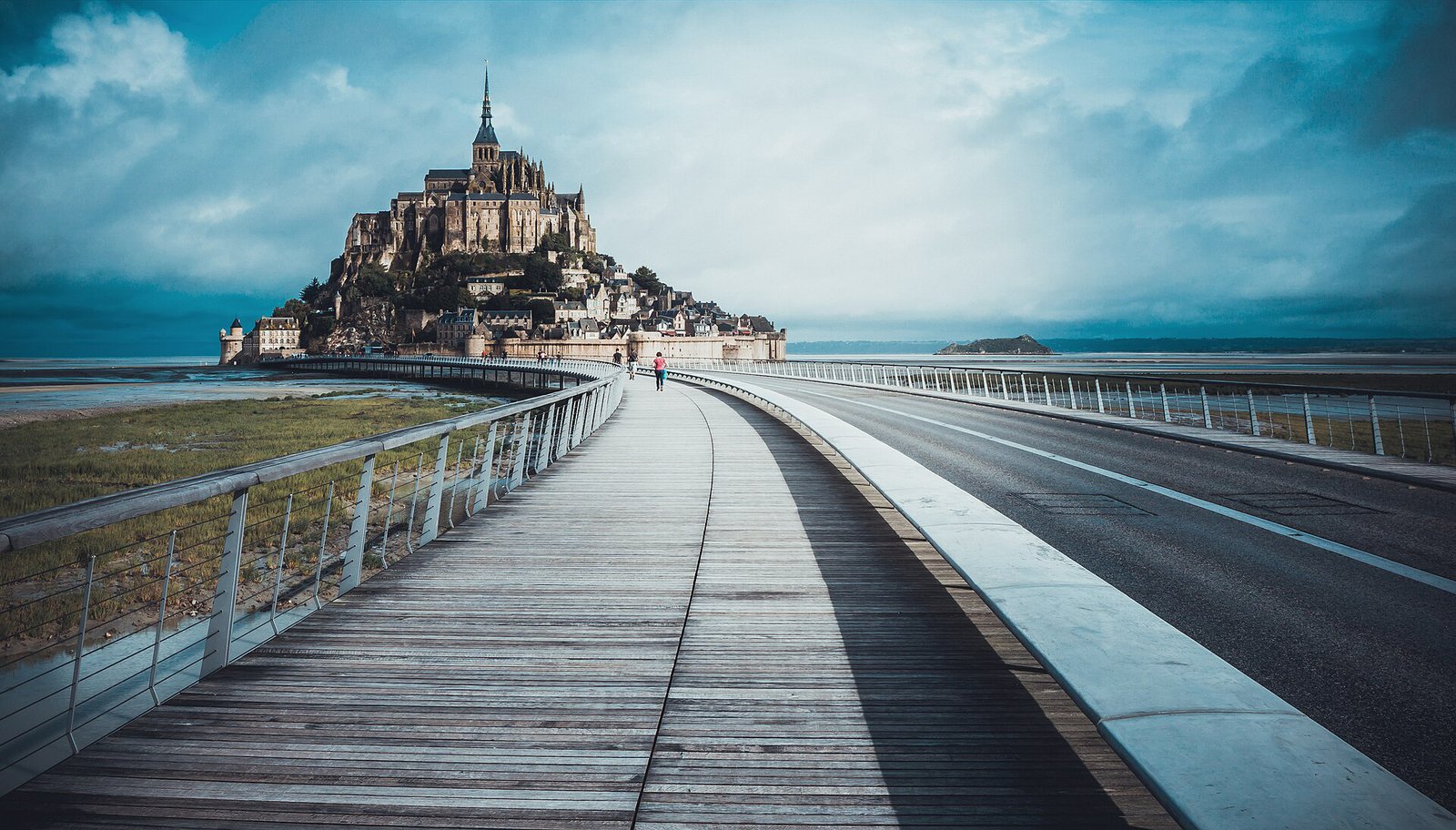
Mont Saint-Michel Photo Guide 2026: Tides, Bay Flats & the Abbey
Mont Saint-Michel is the most photographed silhouette in France, and almost everyone photographs it badly — from the middle of the bridge, at noon, shoulder to shoulder with two thousand other people. The difference between that shot and the ones you actually want comes down to one document: the tide table. The bay has the biggest tides in continental Europe — the sea can rise and fall by more than 12 metres on big coefficients — and everything worth shooting here, from mirror reflections to an island fully ringed by water, is scheduled by the moon, not by your itinerary. Here is the honest version of how a photo day at the Mont really works.
4 photo spots in Mont Saint-Michel — click a pin to open the full guide
Read the tide table before you plan anything else
This is not a composition tip, it is a safety rule. The tide comes in fast across flats that look perfectly walkable, channels fill in behind you before you notice them, and parts of the bay hold genuine quicksand. People get pulled out of the mud here every single season. Two non-negotiables:
- Never walk out onto the bay flats alone. Crossings are done with licensed local guides who read the sands and the timing every day. Book one — it is also the only sensible way to get the wide, low-angle frames from inside the bay itself.
- Check the day's tide times and the coefficient at the tourist office or in an official tide table before you fix your schedule. A coefficient above roughly 90 means big water: the Mont becomes a true island and the sea reaches the ramparts. A coefficient in the 30s to 50s means the water may sit kilometres away all day.
Plan the shoot around those two numbers first. Everything below assumes you have.
Low tide: the mirror flats
When the sea retreats, it leaves thin sheets of water on the sand near the bridge. On a windless morning these turn into perfect mirrors — the Mont doubled, top and bottom, in one frame. Stay on the firm sand close to the footbridge and its western side; you do not need to go far, and you should not. Bare feet or rubber boots, trousers rolled up, and respect the incoming time you noted earlier: set a hard turnaround alarm at least 30 minutes before the tide turns.
One more honest note: the flats are mud as much as sand in places. The dark, silty patches pull at your feet — keep to the pale, rippled sand and you stay on top of it. There are rinse points near the shuttle stops that will save both your shoes and your rental car.
Dawn: the causeway and the sheep meadows
Sunrise is the local hour. The polder meadows around Ardevon and Beauvoir graze the famous salt-marsh sheep, and a flock in the foreground with the Mont floating behind it in pink mist is the picture the postcards never quite manage. Walk the lanes between La Caserne and the villages, or shoot from the meadow edges — stay outside the fenced grazing land. The first shuttles run early, but walking the 2.5 km bridge at dawn is itself part of the experience: you will likely have it almost to yourself.
Surviving the middle of the day
Day-trippers arrive in waves from roughly 10:30, and the Grande Rue becomes a single slow queue until late afternoon. Do not fight it. The mid-day plan that works: be inside the abbey right at opening time, while the tour groups are still on their coaches, or spend the crowded hours on interiors — the cloister and the abbey halls are lit by stone and window light and photograph well whatever the sun is doing outside. The village lanes empty dramatically after about 18:00 when the coaches leave; that evening window inside the walls is quietly the best street-level light of the day.
What clients say about this kind of shoot
Aurélie was the photographer for our wedding in June 2026, and we couldn't be happier with her work. Everything went perfectly, from the initial booking and planning call to the wedding day itself, right through to the delivery of our photos. Aurélie was incredibly kind, thoughtful, and supportive throughout the entire process. She took the time to listen to our wishes while also suggesting photo ideas we would never have thought of ourselves — and we are so grateful to have those memories today. The photographs are absolutely beautiful and perfectly reflect the style shown on her website. She was also extremely responsive to our emails and always took the time to answer every question we had. A huge thank you for your professionalism, your kindness, and for giving us such a beautiful lasting memory of our wedding day. ❤️
— Julia & Mehdi on Aurélie B.
Aurélie is an incredible photographer — available, attentive, diligent and, above all, extremely talented. We chose her to photograph our wedding, and we immediately felt we were in the best of hands. She approaches every wedding as a unique story, taking the time to understand each couple so she can create images that truly reflect who they are, while bringing her own artistic touch. She is both discreet and incredibly patient, while remaining highly efficient. Her photographs are beautiful, full of life, and capture genuine moments, details and portraits with remarkable spontaneity. Every image perfectly reflects the atmosphere of the day. In short, you can trust her completely. Thank you again!
— Louise & Martin on Aurélie B.
We turned to Aurélie to capture our wedding, and we couldn't have dreamed of a better photographer for such an important day. Her work is quite simply exceptional. The photos are beautiful, natural, elegant and, above all, full of emotion. She captured all those little moments we sometimes hadn't even noticed on the day, and that let us relive it today with the very same feeling. What we particularly loved about Aurélie is her discretion. She knows how to be in the right place at the right moment, without ever being intrusive. You completely forget the camera is there, which is what makes the shots so spontaneous and genuine. Beyond her talent, Aurélie is a lovely person — gentle, professional and attentive. She put us at ease and blended perfectly into our wedding and among our guests. We are more than delighted with the result and we will treasure these photos all our lives. Thank you so much, Aurélie, for immortalising one of the most beautiful moments of our life. We recommend her with our eyes closed to every future bride and groom! 🤍
— Alizee & Arthur on Aurélie B.
We received the album and we absolutely love it. The photographs are stunning. The design of the box is perfect — so elegant and chic. Thank you again for all these beautiful memories.
— Anne-Sophie & Biskher on Aurélie B.
Aurélie, by all the gods (if they even exist)… as always, absolutely breathtaking. We'll take the time to truly enjoy them and bring them to life beyond the screen. In the meantime, with just one glance, you've already taken us right back to that wonderfully unforgettable day. Thank you a thousand times.
— Manon & Axel on Aurélie B.
Blue hour from the dam
The Couesnon dam at the mainland end of the bridge has a public deck aligned exactly on the axis of the Mont. From here, roughly 20 to 40 minutes after sunset, you get the classic blue-hour frame: the abbey illuminated, a deep blue sky, the river leading the eye straight in. Bring a tripod or brace the camera on the railing. And if your dates line up with a big coefficient and an evening high tide, this is the one — the Mont ringed by water, lit against the dusk.
Sleeping close enough to catch first light
First light waits for nobody, so sleep next to it. The honest ranking: on the Mont itself (a handful of hotels, small rooms, real money — but you are inside the walls before the first coach arrives); La Caserne at the mainland foot of the bridge, where you step out of the door onto the causeway; or the guesthouses of Beauvoir and Ardevon, five minutes from the shuttles and right beside the sheep meadows. Pontorson works too, with a short early-morning drive.
Get the shot without the guesswork
A local photographer already knows this week's tides, where the mirrors form and at what hour the lanes go quiet — and turns that into frames instead of guesses. Photo France sessions at Mont Saint-Michel start from €299, whether you want a dawn couple shoot on the flats or a family session on the causeway with the abbey behind you. Browse our photographers, read their verified reviews, and let the tide table do the scheduling for you.
Frequently asked questions
What is the best time of day to photograph Mont Saint-Michel?
Sunrise and blue hour. At dawn the salt-marsh meadows around Ardevon and Beauvoir put grazing sheep in front of the Mont in pink mist, and the 2.5 km bridge is nearly empty. Day-trippers arrive from about 10:30, so spend the middle of the day inside the abbey. The lanes empty again after about 18:00, and the deck of the Couesnon dam gives the classic illuminated frame twenty to forty minutes after sunset.
Can I walk out onto the bay flats for photos?
Not alone. The tide comes in fast across sand that looks walkable, channels fill behind you, and parts of the bay hold real quicksand. Crossings are done with licensed local guides who read the sands every day. For the mirror reflections you do not need to go far: stay on the firm, pale sand near the footbridge, check the day's tide times first, and set a hard turnaround alarm at least thirty minutes before the tide turns.
When is Mont Saint-Michel completely surrounded by water?
Only on big tides. Check the coefficient in an official tide table: above roughly 90 the sea reaches the ramparts and the Mont becomes a true island, while coefficients in the 30s to 50s can leave the water kilometres away all day. If your dates line up with a big coefficient and an evening high tide, the view from the dam at blue hour, with the abbey lit and ringed by water, is the shot to plan for.
Where should I stay to catch first light at Mont Saint-Michel?
As close as you can afford. A handful of hotels sit on the Mont itself, inside the walls before the first coach arrives; La Caserne at the mainland end of the bridge puts you straight onto the causeway; and the guesthouses of Beauvoir and Ardevon are five minutes from the shuttles, beside the sheep meadows. Pontorson works with a short early drive. A Photo France session here starts at €299, with a local photographer who already knows the week's tides.
Want professional photos at Mont Saint-Michel?
Browse portfolios, compare packages, and book a verified local photographer in minutes.