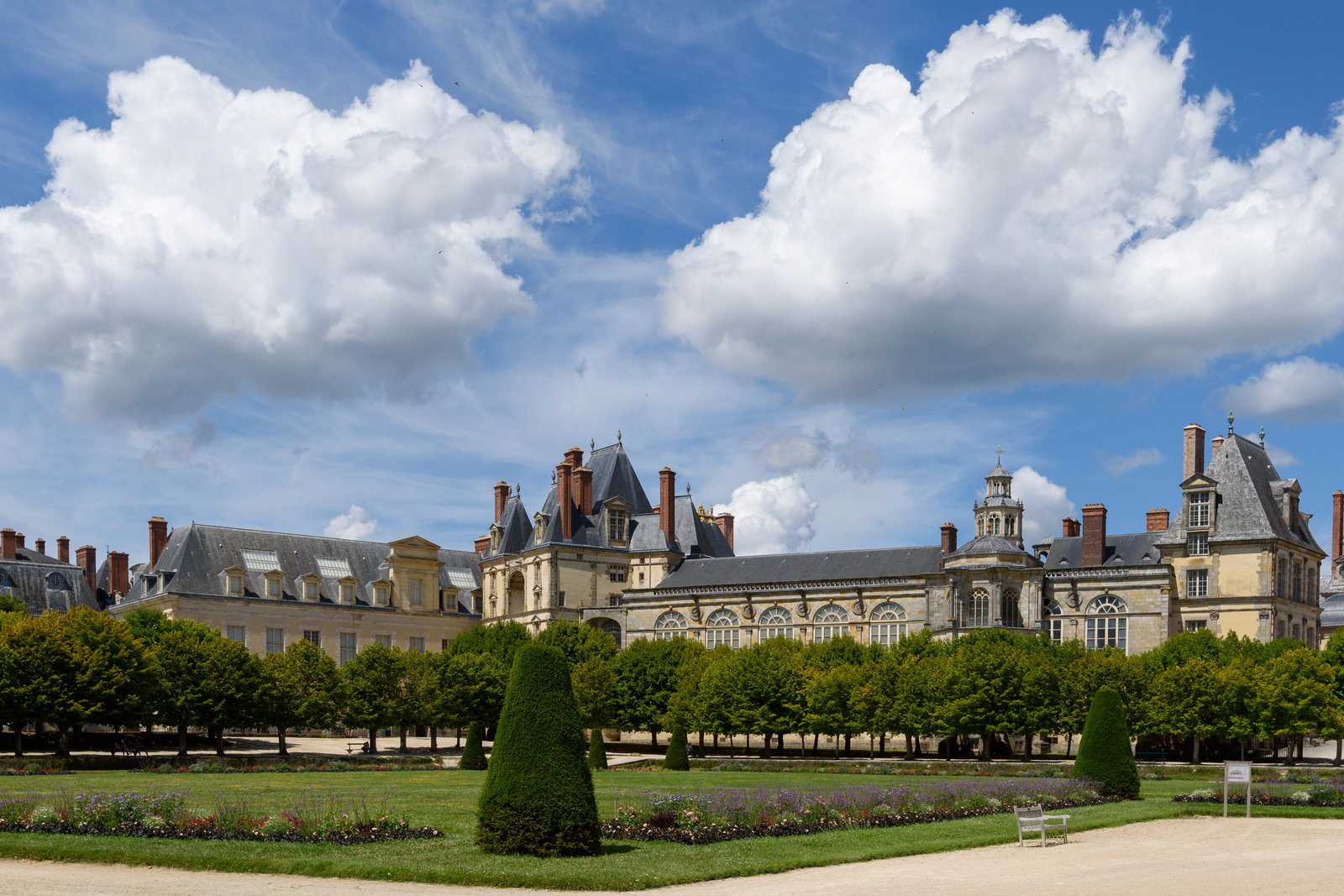
Photo spot in Fontainebleau & Vaux-le-Vicomte
The horseshoe staircase, Cour du Cheval Blanc
Two curving arms of stone dropping into an enormous empty courtyard — the staircase where Napoleon said goodbye to his guard.
About The horseshoe staircase, Cour du Cheval Blanc
Get directionsThe Escalier en fer à cheval was built in 1634 by Jean Androuet du Cerceau: two curved flights that leave the first floor, swing outward and meet again on the gravel of the Cour du Cheval Blanc. It is the front door of the château and the single most recognisable thing at Fontainebleau — and because the courtyard is enormous, you can shoot it from thirty metres back with nothing else in the frame.
Three frames work here. Dead centre from the far end of the courtyard, symmetrical, tiny figures at the foot of the stair; halfway up one arm, looking along the curve; and from the side, where the balustrade runs as a line across the facade. The gravel is pale and acts as a natural reflector under all of them.
The courtyard faces roughly west, so morning light rakes across the facade from the side and the evening sun comes straight in — golden hour here is the whole building lit at once. Overcast is workable too because the pale stone and gravel keep the exposure open.
Timing beats everything: the gardens open before the château, so the first hour of the day gives an empty courtyard, and by mid-morning there are queues, coaches and a car park in view. Note also that this is a national estate with its own conditions for professional photography — check them before a session is booked in the courtyards.
Best time to shoot
The first hour after the gardens open, or golden hour when the sun comes straight in
Tips
Pale gravel acts as a reflector. National estate with its own rules for professional shoots — check before booking the courtyards.
Recent work in Fontainebleau & Vaux-le-Vicomte
Portfolio shots by photographers covering this area
Yuliia B.
View profile →
Yuliia B.
View profile →
Yuliia B.
View profile →
Yuliia B.
View profile →
Yuliia B.
View profile →
Yuliia B.
View profile →
Yuliia B.
View profile →
Natalia D.
View profile →
Yuliia B.
View profile →
Yuliia B.
View profile →
Natalia D.
View profile →
Yuliia B.
View profile →
Yuliia B.
View profile →
Yuliia B.
View profile →
Yuliia B.
View profile →
Yuliia B.
View profile →
Yuliia B.
View profile →
Yuliia B.
View profile →
Yuliia B.
View profile →
Yuliia B.
View profile →
Natalia D.
View profile →
Natalia D.
View profile →
Natalia D.
View profile →
Natalia D.
View profile →
Yuliia B.
View profile →
Yuliia B.
View profile →
Yuliia B.
View profile →
Yuliia B.
View profile →
Yuliia B.
View profile →
Yuliia B.
View profile →
Yuliia B.
View profile →
Natalia D.
View profile →
Photographers who shoot at The horseshoe staircase, Cour du Cheval Blanc
Hand-picked professionals working in Fontainebleau & Vaux-le-Vicomte

Real reviews from Fontainebleau & Vaux-le-Vicomte photoshoots
Aneizi S.
Deciding on a photographer for my trip to Paris with my wife was an absolute headache. I had a previous negative experience with a photographer which was a costly error, and the competition for photographers to capture couples shots in…

Joseph J.
Photographer
Zohar S.
Hello everyone, If you looking for the perfect partner/right hand/a true professional for your needs - you are exactly where you need to be, and Joe is exactly what you looking for! For everyone who care for the little details as well as…
Joseph J.
Photographer
Wilona
He was genuinely brilliant! He suggested beautiful spots for our couple shoot and knew how to guide us while still letting us enjoy the moment. He was present and available all day long, without ever seeming to tire! He even did far more…

Adel B.
Photographer
Other spots in Fontainebleau & Vaux-le-Vicomte
The château gardens and the Grand Canal
Free to walk: a bronze fountain under old planes, Le Nôtre's parterre, a carp pond with an island pavilion, and a canal dug in 1609.
The forest boulders at the Gorges d'Apremont
Fields of grey sandstone blocks in open heath and oak — the landscape the Barbizon painters came for, ten minutes from the château.
Château de Vaux-le-Vicomte
A domed façade above a moat with two kilometres of Le Nôtre parterres behind it — the rehearsal for Versailles, still privately owned.
Ready to book?
Our concierge team will hand-pick 2-3 photographers who know The horseshoe staircase, Cour du Cheval Blanc — free of charge.